Repair or Replace That Fryer? Price the Next Year, Not Just the Service Call
A useful equipment decision weighs installed cost, likely downtime and usable capacity against the price of keeping an aging fryer running.
By Tom Brennan, Senior Writer · · 6 min read
This is practical analysis. Examples are illustrative composites, not reports on specific restaurants.
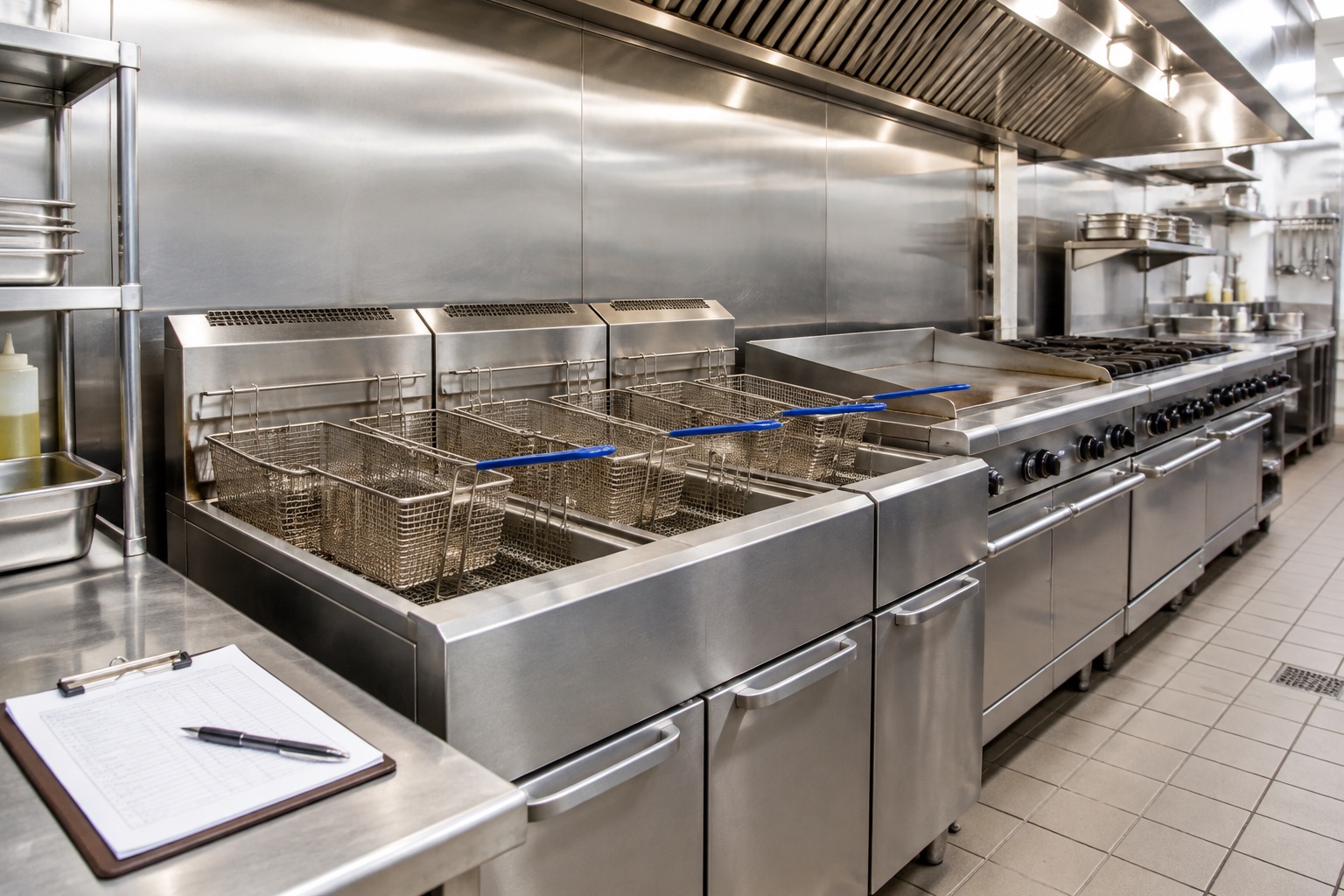
A fryer stops recovering temperature during Friday dinner, and the technician offers two options: authorize another repair or start shopping. Neither the repair invoice nor the equipment catalog answers the real question. What will dependable frying capacity cost over the next year, and how much uncertainty can the restaurant absorb? An illustrative neighborhood grill facing a $1,450 repair on an older fryer should compare complete operating scenarios, not treat the latest breakdown as an automatic order to replace it.
Build two comparable cost estimates
Start with a written diagnosis from a qualified service provider. Ask which component failed, whether the proposed work addresses the underlying cause and what other defects are visible. A failed control and a compromised frypot are different purchasing problems. Record the equipment model, serial number, service history and warranty status. Do not authorize continued operation when the technician identifies an unsafe condition, and do not let a financial comparison override required repairs or applicable safety requirements.
For the repair scenario, separate the quoted work from other spending likely during the comparison period. In the grill example, assume a $1,450 repair, $600 of other reasonably anticipated service and $500 of incremental downtime costs. That produces a $2,550 planning estimate, not a promise. The downtime allowance should reflect extra labor, emergency rentals or lost contribution from unavailable items. Avoid counting all lost sales as lost profit, and do not charge the scenario twice for the same disruption.
For replacement, request an installed quote rather than a countertop price. Suppose the new fryer costs $5,800, with $900 for delivery, installation and removal, plus $300 in commissioning or other required work. The initial cash requirement is $7,000 before financing costs or any applicable taxes not already included. Confirm utility compatibility, clearances, ventilation requirements and local approvals with the appropriate professionals. A cheaper unit that requires unexpected site work may be the more expensive purchase by opening night.
Put capacity and downtime into dollars
Now test whether replacement changes actual production. A fryer with more advertised capacity has little value if the landing area, breading station or exhaust system constrains the line. Measure a representative busy period: portions cooked, basket cycles, recovery delays and items waiting for fryer space. Use the menu and product specifications the restaurant actually serves. A vendor demonstration can inform the decision, but it should not substitute for an operational test that includes the kitchen’s real holding and finishing steps.
Assume, strictly for planning, that a suitable replacement prevents $900 in service and disruption costs and produces $700 in verified labor or utility savings over a year. Those $1,600 in benefits do not repay a $7,000 purchase in twelve months. That does not make replacement wrong; it clarifies that the decision also depends on useful life, future repair exposure and available cash. Treat energy or oil savings as estimates until measured under comparable operating conditions, not as guaranteed offsets.
Build a second case in which the repair fails to deliver a stable year. What happens if parts take ten days to arrive during the holiday period? Identify an alternative menu, available rental equipment and the contribution at risk. If the grill can shift demand to other profitable items, its exposure differs from that of a chicken concept built around frying. Apply the same discipline to replacement: delivery delays, installation downtime and unfamiliar controls can also interrupt service.
- Obtain an itemized diagnosis and repair warranty.
- Request a complete installed replacement quote.
- Compare equivalent production capacity, not cabinet width.
- Estimate downtime using lost contribution and added expenses.
- Verify utility, ventilation and installation requirements.
- Keep a contingency allowance separate from the base estimate.
Make the decision before the next failure
Cash timing matters even when replacement looks better over several years. A $7,000 payment may compete with payroll, taxes and seasonal inventory. Financing spreads the payments but adds cost and may carry fees or personal guarantees. Compare total payments and payment dates with a conservative cash forecast. Do not assume a tax deduction makes the equipment free; ask the restaurant’s accountant how the purchase or repair would be treated in the business’s specific circumstances.
Set a decision rule the manager can use without restarting the argument at every service call. The grill might approve the current repair only if the technician confirms the unit can operate safely, critical parts remain available and the revised twelve-month estimate stays below an agreed ceiling. A second major failure could trigger replacement review rather than another automatic authorization. The ceiling should follow the restaurant’s economics and risk tolerance, not a universal percentage of the original purchase price.
Finally, preserve the information that made the decision possible. Keep service invoices, downtime hours, oil-management records and installed quotes together. Assign someone to check whether the repaired fryer performs as expected after the first week and month. If replacement wins, schedule installation away from peak demand and train the crew before full service. The goal is not to defend old equipment or favor new equipment. It is to buy dependable production without confusing an urgent repair with an informed capital plan.
Operator checklist
- Get a written diagnosis that distinguishes the failed part from underlying problems.
- Compare twelve-month repair and replacement scenarios using consistent assumptions.
- Include installation, removal, financing and interruption costs.
- Verify claimed capacity and operating savings against the actual menu.
- Set a repair ceiling and a documented replacement trigger.
Spot an error? Request a correction. Read our editorial standards.
More from Foodservice Journal
Give the Walk-In a Maintenance Schedule Before It Gives You an Emergency
A practical cooler program separates daily operating checks from qualified service work and gives every exception an owner.
Kitchen & Equipment · Tom Brennan · October 21, 2026
Count the Walks: A Low-Cost Test for a Faster Kitchen Line
Mapping repeated trips can uncover wasted motion, but layout changes should improve complete tickets rather than simply make one station faster.
Kitchen & Equipment · Tom Brennan · September 29, 2026
A Shorter Menu Only Pays When the Prep List Shrinks
Cutting dishes can simplify service, but the larger savings come from eliminating ingredients, prep tasks and purchasing exceptions.
Restaurant Trends · Grace Whitfield · November 24, 2026