A Shorter Menu Only Pays When the Prep List Shrinks
Cutting dishes can simplify service, but the larger savings come from eliminating ingredients, prep tasks and purchasing exceptions.
By Grace Whitfield, Staff Writer · · 6 min read
This is practical analysis. Examples are illustrative composites, not reports on specific restaurants.
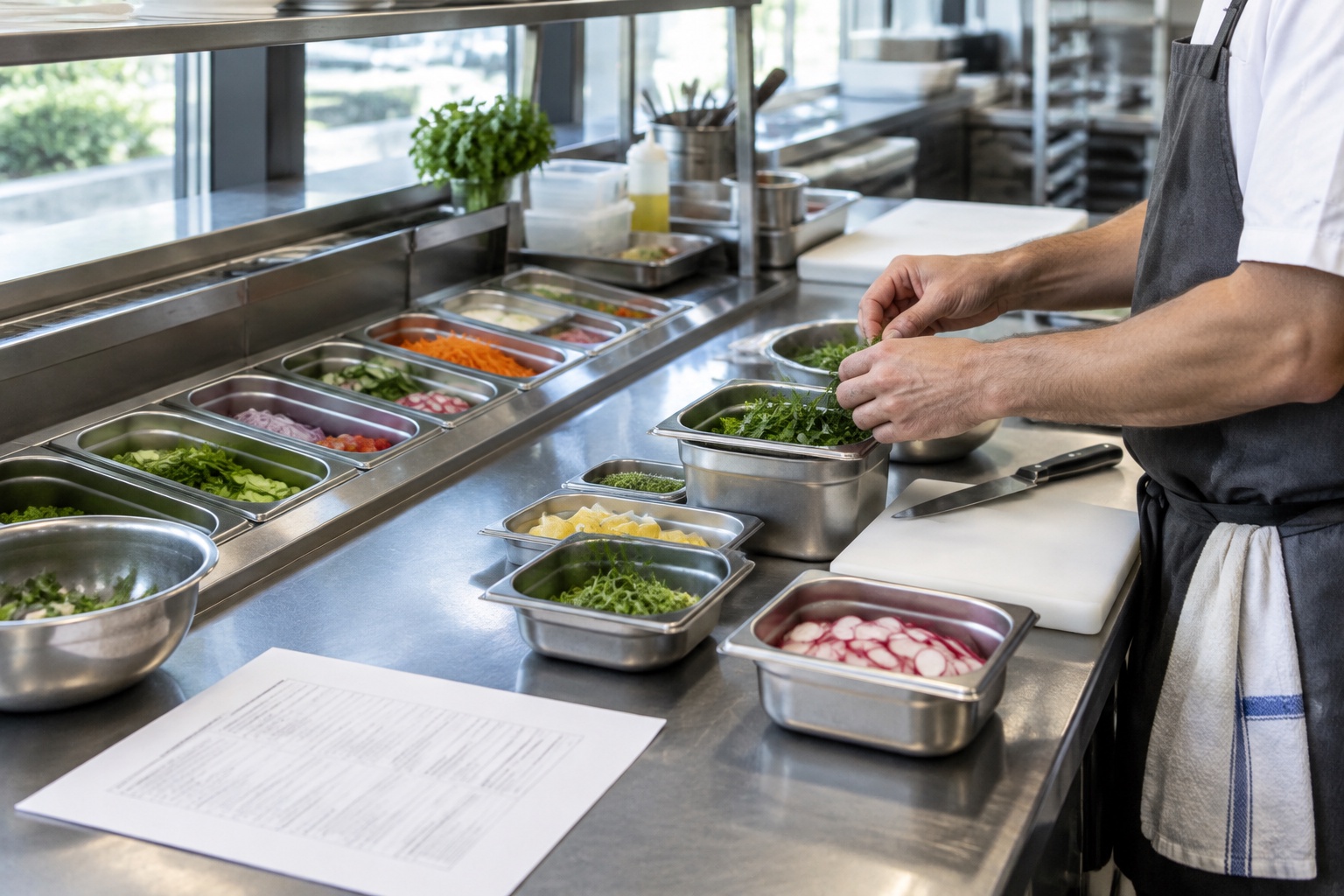
A restaurant can remove eight dishes and still open the same number of ingredient containers every morning. That is the central problem with menu reduction as a cost strategy: fewer printed choices do not automatically mean less work. If the remaining dishes retain every sauce, garnish and specialty protein, the kitchen may carry almost the same inventory and preparation burden. For operators considering a smaller menu, the useful starting point is not the page count. It is the purchase order, followed by the prep sheet and the station setup.
Consider an illustrative neighborhood restaurant with 42 food items and 96 purchased ingredients. Its first proposed edit removes six slow sellers but eliminates only three ingredients because most components appear elsewhere. A second version removes five dishes and changes four others, retiring 14 ingredients and two daily sauce preparations. The second version deserves closer examination even though its menu is technically longer. Neither plan guarantees savings, but only one clearly changes the work that employees perform before the first guest arrives.
Map the work behind each dish
Build a simple ingredient-to-dish map using actual recipes rather than menu descriptions. Record purchase pack size, usable yield, shelf life after opening, weekly usage and every menu item that consumes the ingredient. Add preparation tasks separately. A purchased sauce and a house-made sauce may each count as one ingredient on a recipe card, yet their labor demands differ substantially. Flag components used by only one dish, but do not assume they should disappear. A distinctive, profitable signature item can justify an otherwise inconvenient ingredient.
Sales mix needs a companion measure: contribution dollars after food cost, not food-cost percentage alone. In an illustrative comparison, a $24 entree with $9 in ingredients produces $15 before labor and other expenses, while a $17 entree with $4 in ingredients produces $13. The cheaper dish has a better food-cost percentage but fewer contribution dollars per sale. Add preparation time, bottleneck-station demand and waste exposure before choosing a replacement. Also examine what guests buy alongside each entree; removing a dinner favorite may affect beverage or dessert purchases.
- Identify ingredients used in only one dish.
- Separate daily prep from work performed only when ordered.
- Flag large purchase packs with low weekly usage.
- Compare contribution dollars and station demands.
- Note dietary needs and signature dishes that require protection.
Test the purchasing and labor consequences
Inventory savings become real only when purchasing changes. Suppose a composite operation uses four pounds of a specialty cheese each week but must buy a ten-pound case. Removing its only menu application should eliminate that case, not merely move the remaining stock into an untracked special. Establish a dated runout plan and purchasing stop. For ingredients retained across several dishes, update order quantities against the new sales forecast. Otherwise, the first weeks of a tighter menu can produce more waste as habitual orders meet lower demand.
Labor claims need the same discipline. Eliminating 90 minutes of preparation does not necessarily reduce payroll by 90 minutes. The work may be spread among employees who still need their scheduled shifts, or a minimum staffing requirement may remain unchanged. The immediate benefit could instead be a later start for one position, more reliable breaks or less overtime. Write down which outcome is expected and who will adjust the schedule. Count labor savings only when paid hours actually decline without moving unfinished work onto another shift.
The dining room also needs a transition plan. Servers should know which favorites are leaving, what to recommend instead and whether reasonable modifications remain available. Avoid promising that the kitchen can recreate every discontinued dish; that quietly restores the complexity the menu edit was supposed to remove. Keep ordering channels synchronized, including third-party listings and catering documents. A guest who sees an old menu online can turn an otherwise sensible operational decision into a service recovery problem before placing an order.
Judge the edit against a baseline
Run the revised menu long enough to include comparable weekdays and weekends, while separating holidays or unusual events from routine trading. Before launch, record ingredient waste, prep hours, ticket times, item availability and contribution dollars per guest. After launch, compare the same measures and review guest comments for recurring gaps rather than isolated preferences. A decline in average check does not automatically mean failure if labor and waste fall more. Conversely, a cleaner prep sheet is not a win if profitable regular customers stop visiting.
Watch substitution behavior closely during the test. If guests replace a removed high-contribution entree with a lower-contribution sandwich, the apparent purchasing savings may disappear at the check level. If they choose another entree and add a side, the result could be favorable. Servers can record common requests without running an elaborate survey. Managers should also inspect whether cooks are creating unofficial sauces or holding off-menu ingredients for regulars. Those workarounds are evidence that the proposed system and the operating system have started to diverge.
A smaller menu is best treated as an operating design, not a declaration of culinary restraint. Keep items that earn their complexity through demand, contribution or a clear role in the restaurant’s identity. Rework dishes whose ingredients create disproportionate purchasing and prep demands. Then make the changes visible in orders, schedules, station diagrams and training. The test is straightforward: when the menu gets shorter, can the manager point to specific work, inventory or waste that has actually disappeared? If not, the editing is not finished.
Operator checklist
- Map every ingredient and preparation task to its menu applications.
- Compare contribution dollars, demand and station workload before cutting.
- Set purchasing stops and runout plans for retired ingredients.
- Translate prep reductions into explicit scheduling or service improvements.
- Track substitution patterns, waste and contribution dollars during the test.
Spot an error? Request a correction. Read our editorial standards.
More from Foodservice Journal
Counter Service in a Full-Service Room Needs a New Labor Plan
Moving orders to a register changes the guest journey, but savings depend on redesigning food running, clearing and peak-hour coverage.
Restaurant Trends · Catherine Hale · November 3, 2026
Value Bundles Need a Contribution Floor, Not Just a Low Price
An attractive meal price can protect traffic, but operators need to account for trade-down, packaging and peak-hour capacity before promoting it.
Restaurant Trends · Grace Whitfield · October 13, 2026
Your Next Hourly Hire Costs More Than the Job Ad
A position-by-position replacement ledger separates recruiting expenses from the training and coverage costs that quietly consume margin.
Staffing · Alicia Moreno · November 20, 2026