Build a Catering Line That Does Not Borrow Dinner’s Labor
A limited menu, capacity-based order caps and complete job costing can make catering a distinct revenue line instead of an expensive favor.
By Marcus Bell, Contributing Writer · · 6 min read
This is practical analysis. Examples are illustrative composites, not reports on specific restaurants.
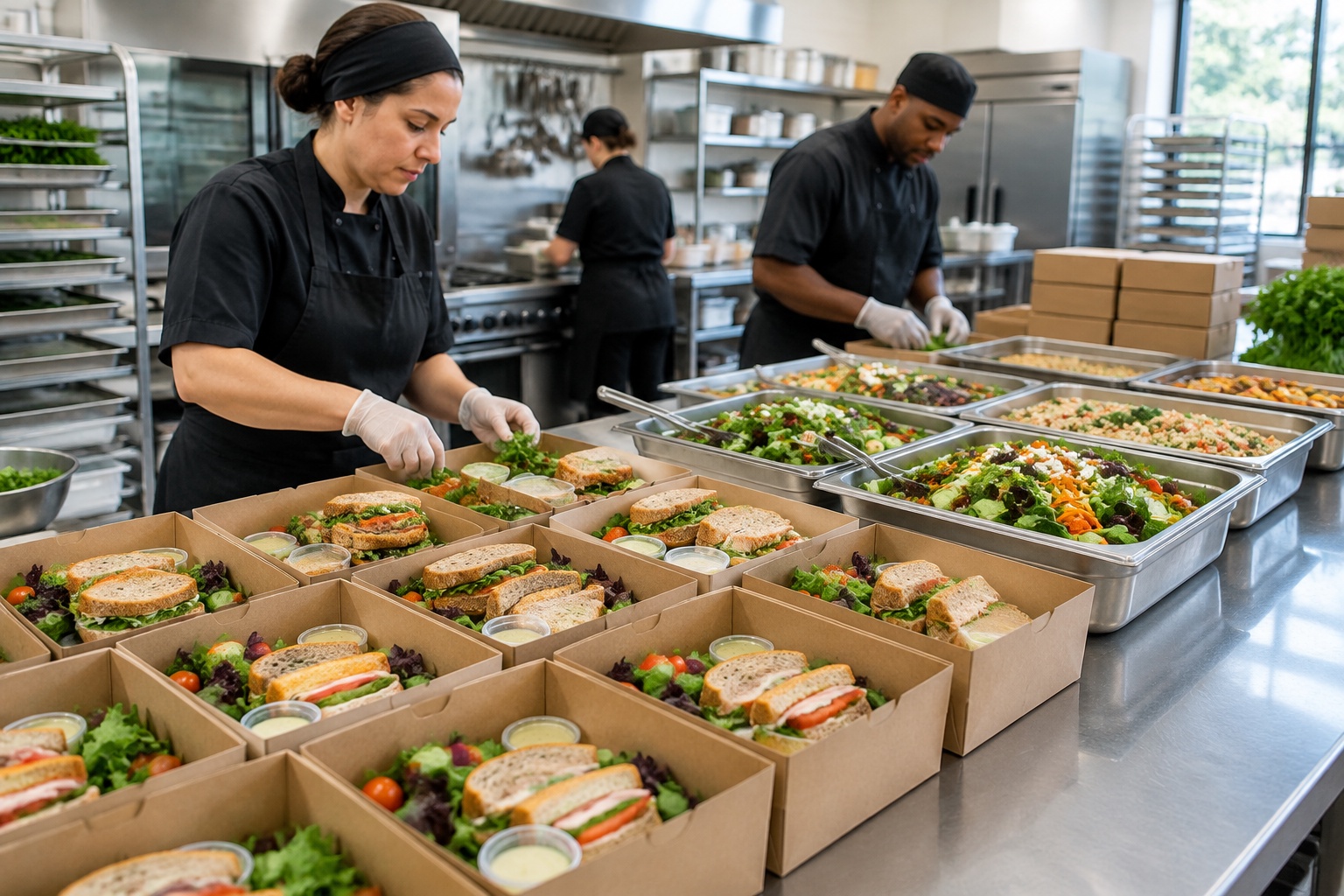
An office lunch order can look like easy incremental revenue until its trays occupy the oven, its driver needs directions and the dining room starts lunch without enough prep. Catering becomes a useful second revenue line when the restaurant defines what it can produce, when it can produce it and what the full job must earn. Consider an illustrative neighborhood restaurant launching a pickup-and-delivery catering menu. Its first task is not building a brochure. It is protecting the existing business while pricing a different production and handoff process.
Design the offer around a production window
Start with items that travel predictably, portion consistently and share ingredients without overwhelming the same equipment. A smaller menu makes forecasting, purchasing and packing easier than offering every dining-room dish in a larger container. Specify serving quantities and what is included: sauces, utensils, plates and setup all carry costs. Test the food after realistic transport and holding, following applicable food-safety requirements. A dish that looks excellent on the pass may be a poor catering product after a vehicle trip and a delayed meeting.
Map the order against the production schedule. Identify the earliest safe prep steps, the final cooking window, cold-storage needs and the equipment required immediately before dispatch. Set order limits around the tightest constraint rather than total kitchen square footage. If oven space allows two large orders before lunch without displacing restaurant production, accepting a third may require a different pickup time or a declined sale. The ability to sell more portions does not establish the ability to fulfill them profitably or safely.
Write the customer-facing boundaries before the first busy week. Include lead times, minimum order value, delivery zones, available time windows and a clear policy for changes or cancellations. Address deposits and payment timing in terms reviewed for the business and its jurisdiction. Explain whether the service is doorstep delivery, room placement or staffed setup. Each option consumes different labor. A request to carry trays upstairs, arrange a buffet and return for equipment should not silently become part of a basic delivery charge.
Cost the whole job, not just the food
Work through an illustrative 40-person order priced at $22 per person, producing $880 in sales before taxes or other applicable charges. Assume $264 in food, $48 in packaging, $150 in incremental production and packing labor, $55 in delivery expense and $26 in payment or ordering fees. Those direct costs total $543, leaving $337 before overhead and other costs. This is a planning example, not a restaurant benchmark. Replace every input with measured costs and avoid counting delivery labor twice.
That $337 is not automatically profit. The order still uses management attention, equipment, space and possibly sales labor. It may also displace more valuable restaurant production. If accepting it forces $80 in overtime and causes $100 in lost contribution elsewhere, only $157 remains before other overhead. Conversely, a genuinely quiet production window can improve the economics. The point is to identify what changes because the order exists, then check whether the remaining contribution adequately supports the resources the catering business consumes.
Build pricing from repeatable packages rather than improvising every quote. Establish portion specifications, optional additions and charges for extra service. Include reasonable waste and packing time in the worksheet, then compare the estimate with actual results after fulfillment. A minimum order or delivery charge should reflect the economics of small jobs, not merely match a nearby competitor. If customers consistently request expensive customization, create a priced option or decline it; a supposedly standard package should not conceal a different menu every week.
- Define portions, included supplies and service level.
- Cap orders by the tightest production or transport constraint.
- Price food, packaging, labor, delivery and fees separately.
- Establish lead times, changes and payment terms.
- Compare estimated contribution with actual results after each job.
Treat handoff and repeat sales as operating work
Give every accepted order a single production record. It should show the customer contact, delivery address, access instructions, promised window, quantities, dietary requests and payment status. Use a packing check that separates food from serving equipment and paperwork. Follow the food-safety plan for temperature control during staging and transport, and make the customer’s handling instructions clear. Avoid making promises about allergen-free production unless the operation can substantiate them. The person loading the vehicle should verify the order rather than rely on memory.
Assign ownership of the customer relationship after delivery. A short follow-up can confirm that quantities and timing worked and identify the next ordering occasion, without promising discounts automatically. Track the source of each inquiry and the time spent converting it. A recurring office customer may justify deliberate account management; a string of one-time, highly customized jobs may not. Obtain appropriate permission for marketing communications and keep ordering contacts current. Repeat business is useful when the restaurant can repeat the economics as well as the sale.
Review the catering line separately each month. Track sales, direct contribution, on-time fulfillment, errors, refunds and the effect on regular service. Look at labor by production window rather than assuming the existing schedule absorbs everything. Expand only after the team can fulfill the current offer consistently and the numbers support it. That may mean adding one delivery window or one tested menu package, not buying a vehicle immediately. A second revenue line should earn additional capacity through repeatable performance instead of repeatedly borrowing it from dinner.
Operator checklist
- Test a limited menu under realistic transport and holding conditions.
- Set daily order caps based on equipment, labor and delivery capacity.
- Include all direct fulfillment costs in the quote worksheet.
- Publish clear lead-time, service-level and payment terms.
- Review catering contribution alongside its effect on regular service.
Spot an error? Request a correction. Read our editorial standards.
More from Foodservice Journal
Before the Second Lease, Test the Sales You Need and the Cash You Can Lose
Expansion deserves separate tests for store economics, opening liquidity and whether the first restaurant can run without its owner.
Growth · Rafael Ortiz · October 16, 2026
Make Loyalty Pay for the Next Visit, Not Discount the One Already Coming
A restaurant loyalty test should measure incremental contribution and repeat behavior, not just enrollment totals and reward redemptions.
Growth · Marcus Bell · September 11, 2026
A Shorter Menu Only Pays When the Prep List Shrinks
Cutting dishes can simplify service, but the larger savings come from eliminating ingredients, prep tasks and purchasing exceptions.
Restaurant Trends · Grace Whitfield · November 24, 2026